
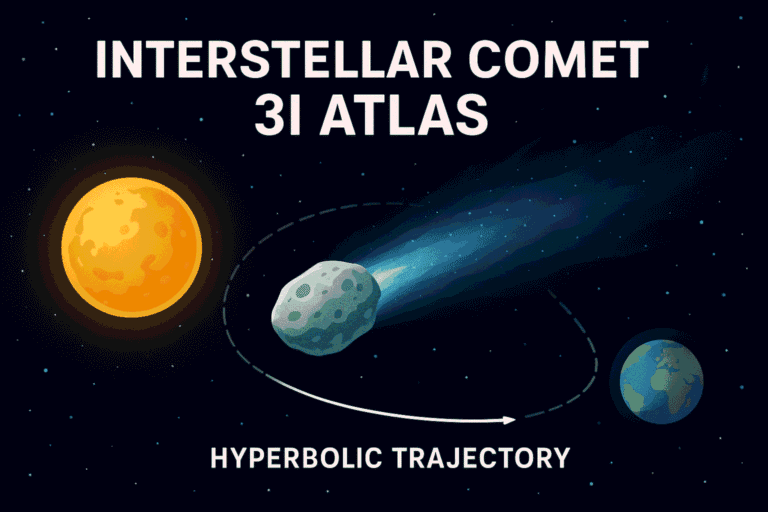
Interstellar Comet 3I ATLAS NASA
The discovery of the interstellar comet 3I ATLAS NASA has taken the scientific world by storm. Only the third confirmed object to enter our Solar System from another star system, 3I/ATLAS is offering astronomers a once-in-a-lifetime chance to study alien cosmic material up close. In this blog, we explore everything about this rare and fascinating celestial traveler — its origin, speed, composition, and why it’s such a scientific treasure.
Table of Contents
⭐ What Is the Interstellar Comet 3I ATLAS NASA?
The interstellar comet 3I ATLAS NASA is the third confirmed interstellar object ever detected. It follows the famous 1I/ʻOumuamua (2017) and 2I/Borisov (2019).
It was discovered on July 1, 2025 by the ATLAS survey telescope in Chile — part of NASA’s planetary defense network.
🧭 Why “3I/ATLAS”?
- 3I = Third interstellar object
- ATLAS = “Asteroid Terrestrial-impact Last Alert System,” the telescope that spotted it
This discovery marks another major leap in the study of interstellar visitors and deep-space chemistry.
🌠 How Was Interstellar Comet 3I ATLAS NASA Discovered?
ATLAS is an advanced sky-survey system designed to detect near-Earth objects, asteroids, and unusual space bodies. On July 1st, astronomers noticed something extraordinary — a rapidly moving object on a hyperbolic trajectory, proving it was not bound to our Sun.
This confirmed its interstellar origin.
☄️ Orbit and Speed of Interstellar Comet 3I ATLAS NASA
The interstellar comet 3I ATLAS NASA is traveling at incredible speeds:
- Detected speed: ~137,000 mph (221,000 km/h)
- Near-Sun speed: ~153,000 mph (246,000 km/h)
Its Journey Through Our Solar System
- Perihelion (closest to Sun): October 30, 2025
- Closest approach to Earth: ~1.8 AU (≈ 270 million km) — perfectly safe
Its path is hyperbolic, meaning it will swing around the Sun once and leave forever, disappearing back into interstellar space.
🔬 Size and Structure of Interstellar Comet 3I ATLAS NASA
NASA’s observations estimate the nucleus to be between:
- 440 meters and 5.6 kilometers across
It has the classic characteristics of a comet:
- Icy core
- Bright coma (gas cloud)
- Dust tail
The coma of the interstellar comet 3I ATLAS NASA contains:
- Carbon dioxide (CO₂) — unusually high
- Water vapor (H₂O)
- Dust and ices
- Traces of carbon monoxide (CO)
Scientists believe its outer layers have been exposed to galactic cosmic rays for millions of years, altering its chemistry in ways rarely seen in Solar System comets.
🧪 Why Is Interstellar Comet 3I ATLAS NASA So Special?
This comet is a time capsule from another star system. Studying it gives scientists clues about:
- How planets and comets form around other stars
- What elements and ices exist in distant planetary systems
- How cosmic rays modify frozen objects in deep interstellar space
🌌 A Scientific Goldmine
NASA and global observatories, including JWST, Hubble, and various radio telescopes, are collaborating to capture as much data as possible before 3I/ATLAS leaves forever.
🛰️ NASA’s Observations of Interstellar Comet 3I ATLAS NASA
NASA has released multiple high-resolution images showing:
- Active outgassing
- A brightening coma
- Sudden eruptions that resemble “ice volcanoes”
Jets of CO₂ and dust shooting from the surface
These rare images help scientists study the chemistry and thermal behavior of bodies formed outside our Solar System.
👽 Is Interstellar Comet 3I ATLAS NASA Artificial or Alien?
NASA has officially confirmed that:
- 3I/ATLAS shows no signs of artificial origin
- It behaves fully like a natural comet
- Any mysterious signals or bursts were caused by normal comet activity
While some fringe theories claim it may be sent to “seed life,” scientists emphasize it is purely a natural interstellar object.
🌟 Why the Interstellar Comet 3I ATLAS NASA Matters for the Future
This comet teaches us that: Interstellar Comet 3I ATLAS NASA
- Our Solar System is not isolated
- Material from distant star systems occasionally passes through
- Interstellar objects may be more common than once believed
- Studying them could reveal how life-forming ingredients travel across galaxies
3I/ATLAS will soon vanish into deep space — but the data it leaves will shape astronomy for decades.
🚀 Final Thoughts
The interstellar comet 3I ATLAS NASA is one of the most fascinating discoveries of the decade. A wandering messenger from a distant star system, it carries secrets billions of years old — and scientists are racing to decode its story before it disappears forever.
This rare visitor reminds us how vast, mysterious, and interconnected our universe truly is.