Table of Contents
India Labour Law 2025 Reform Complete Guide
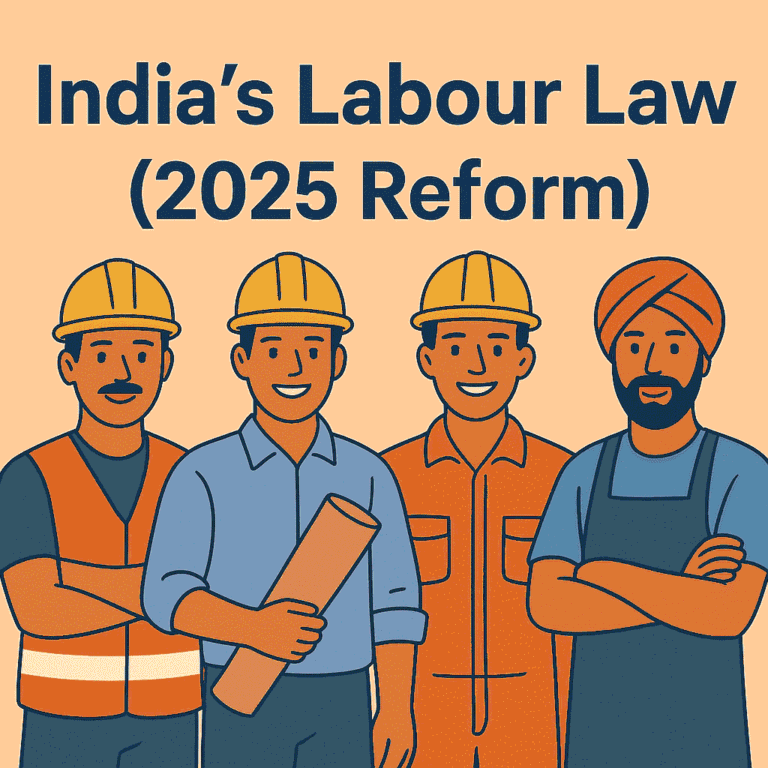
The long-awaited overhaul of India’s labour regulations has finally arrived. On 21 November 2025, the Government of India officially implemented four new labour codes, consolidating and modernizing 29 existing central labour laws.
These sweeping changes—collectively known as India Labour Law (2025 Reform)—aim to streamline regulations, protect workers, boost social security, simplify compliance, and make India’s workforce future-ready.
This blog explains every important point under the new labour codes in a clear, structured way.
1. Introduction to India Labour Law (2025 Reform)
The reform brings together existing labour laws into four comprehensive codes:
Code on Wages (2019)
Industrial Relations Code (2020)
Social Security Code (2020)
Occupational Safety, Health & Working Conditions (OSHWC) Code (2020)
These four codes replace 29 fragmented laws, creating a unified, simplified, and digitized labour framework.
India Labour Law 2025 Reform Complete Guide.
2. Overview of the Four Labour Codes
2.1 Code on Wages (2019)
The Code on Wages aims to create a more uniform wage system across India.
Key Features
Uniform definition of ‘wages’
At least 50% of total salary must be counted as “basic wages.”National floor wage
A statutory floor wage will apply across the country.Equal pay for equal work
No gender-based wage discrimination.Timely payment of wages
Ensures workers are paid within fixed timelines.2.2 Industrial Relations Code (2020)
This code governs trade unions, industrial disputes, and working conditions.
Key Features
Layoff & retrenchment threshold increased
Companies with up to 300 employees can now hire and fire without government approval (previous limit: 100).14-day strike notice mandatory
Applies to public utility and non-utility sectors.Grievance Redressal Committees in firms with 20+ workers.
Fixed-term employment allowed across all sectors.
2.3 Social Security Code (2020)
This code greatly expands the scope of social security benefits.
Key Features
Coverage for gig & platform workers
Delivery workers, cab drivers, and online platform workers are formally recognized.Social security fund
Technology aggregators must contribute to a welfare fund.Gratuity for fixed-term workers
Eligible after 1 year, instead of 5 years.Wider accessibility to EPFO and ESIC
Extends benefits to unorganised-sector workers.
2.4 Occupational Safety, Health & Working Conditions (OSHWC) Code (2020)
This code focuses on workplace safety, welfare, and working hours.
India Labour Law 2025 Reform Complete Guide
Key Features
Maximum daily work hours: 12 hours (weekly cap stays at 48 hours).
Mandatory annual health check-ups for workers aged 40+.
Consent-based night shifts for women with safety provisions.
Single license for contractors across multiple states.
Improved digital inspection mechanisms.
3. Major Changes Under India’s Labour Law (2025 Reform)
3.1 Unified and Simplified Compliance System
One registration
One license
One return filing
This drastically reduces paperwork for businesses.
3.2 Digitized and Risk-Based Inspections
Inspections are now:
Automated
Risk-based
Less discretionary
This reduces corruption and improves transparency.
3.3 Broad Social Security Expansion
Social security benefits now extend to:
Gig workers
Platform workers
Unorganised workers
This is one of the most transformative parts of India’s Labour Law (2025 Reform).
3.4 Pay Structure Changes
Because basic wages must form at least 50% of total pay:
PF contributions may increase
Take-home salary may change
End-of-service benefits become higher
3.5 New Rules for Hiring & Firing
The raise in the retrenchment threshold to 300 workers aims to give industries more flexibility.
3.6 Stricter Regulations on Strikes
Workers must provide a 14-day notice before any strike action.
The goal: reduce sudden disruptions and encourage dialogue.
4. Impact on Different Stakeholders
4.1 Impact on Workers
More predictable wages
Better social security
Stronger workplace safety
Medical check-ups for older workers
Opportunity for flexible employment (fixed-term jobs)
4.2 Impact on Gig & Platform Workers
For the first time, gig workers receive:
Insurance
Health benefits
Old-age protection
Disability coverage
Companies like food delivery apps, ride-hailing apps, and e-commerce platforms must contribute to a special fund.
4.3 Impact on Employers
Benefits:
Simplified compliance
Centralized license process
Digital inspections
Challenges:Higher contributions (PF, social security)
Mandatory medical tests
Stricter working-hour norms
4.4 Impact on Economy
The reform aims to:
Improve ease of doing business
Reduce legal complexity
Boost competitiveness
Protect vulnerable workers
5. Why India’s Labour Law (2025 Reform) Is Considered Historic
The reform is considered the biggest labour law change since independence because it:
Simplifies 29 laws into 4 codes
Brings gig economy into formal regulation
Aligns India with international labour standards
Promotes digital governance
Balances worker welfare with employer flexibility
6. Concerns & Criticisms
Trade unions and labour groups have raised concerns:
12-hour workdays may be too demanding
Hire-and-fire flexibility may weaken job security
State-level implementation may cause inconsistency
Gig worker protections depend on contributions from large platforms
Nationwide strikes have been organized in response.
7. Conclusion: What India’s Labour Law (2025 Reform) Means for the Future
India Labour Law (2025 Reform) marks a significant turning point in India’s economic and labour landscape.
These reforms modernize outdated laws, expand social security to millions, and streamline compliance for businesses.
While there are concerns regarding working hours and job security, the reforms attempt to balance economic growth with worker welfare.
As states roll out their own rules, the effectiveness of the new codes will become clear in the coming months.